

You can leave the door open without standing in the doorway waiting.
Nobody teaches you how to grieve the loss of someone who’s still alive. You don’t get a funeral or an obituary or some socially acceptable form of mourning where people bring you food or a condolence card. You don’t even get an ending because your story and theirs keep going. Instead, we get being left on read, seeing a place that holds a beautiful memory but is now tainted with heartache, and, in my case, a friendship that still exists in my heart but no longer feels safe in my life. The most frustrating part is being unable to stop loving the person who broke your heart. I love him. I miss him. I want to understand his pain. I want things to work out. But I’m also fucking exhausted.
That’s what I’m learning through my friendship with Ray.
Ray is —was?—my best friend of three years. We first met through work when I was searching for someone to speak at a conference, and an acquaintance gave me Ray’s number. When we met, there was a moment that felt like a spark between two kindred souls. Not the romantic kind of spark, but the kind that says, “You get me.” We’re both sex workers, we’re both Aquariuses since our birthdays are two days apart, and we’re both homophobic in the way that any gay man can be homophobic. It’s a spark of mutual understanding and reciprocated kinship. Ray slowly shifted in my life to be more than just someone I took on for work. He became my mentor, my coach, and my best friend.
Ray and I would train together; we would laugh at the same stupid media, share a joint, and we could talk for hours on end about anything. Politics, what we learned in therapy, how his journey as a therapist is going, hot goss, you name it, we can yap about it. We shared our hopes and dreams to each other. We talked about our fears, anxieties, insecurities. We weren’t afraid to be vulnerable around each other because we trusted each other. Our friendship was so palpable that other people in the gym noticed. Some asked if we were dating, and others would even say how much they “love our love.” We were two peas in a pod; at least that’s what it felt like to me. I felt that our friendship wasn’t just about having someone to hang out with. To me, I felt safe. We could trust each other, share experiences, learn from each other, and I found community in him that I couldn’t find in a long time. When a connection like that ruptures, I’m not just grieving that person. I’m grieving the life that could have been when I thought he would be part of my story.
The pain we don’t know we cause
Ray lives in the gay village. Earlier this year during Pride, he invited me over to stay at his place so that I don’t have to schlep an hour and a half to go home after a night of festivities. I thought what an extremely kind gesture! I was also thinking of how he was holding up because Ray had disclosed to me that, because of his drug addiction, Pride can be a bit triggering. Not wanting to make matters worse for him, I decided to hold back on inviting him out to any events.
I went to his place, said hi to him and chatted a bit, dropped off my stuff, and went out. I partied for maybe five hours max and got back to his place around 1 am. He had been sleeping by this time, so I took a shower and went to bed. The next morning, I woke up and knocked on his door to see how he was doing.
“What?!” he answered in a surprisingly angry tone.
“Everything okay? Just wanted to see how you’re doing,” I replied, a little wary.
“Yeah, everything’s fine. Want some breakfast?”
I hesitated to respond because I sensed something was up, but I took him at his word and thought everything was indeed fine.
We ate at the breakfast table where he gave me a bagel and coffee. I had to go to work that day, so I took my half-eaten bagel with me, thanked him so much for his hospitality, and went on my way. In that moment, I considered myself so lucky to have him as my best friend.
What I didn’t know was how he was truly feeling, and this would come back to bite me in the ass later.
A one-two-three punch
Punch one: July rolls around. I’ve been working at a big-name gym (let’s call it HeavyLifting) for three months at this point. One day, my boss calls me into her office to tell me that I’m being laid off because I spoke about sexual health to a colleague. That pussy, bitch-ass colleague ratted me out, and I’m now banned from entering any HeavyLifting gyms or its subsidiaries for two years. While the official termination letter says that I’m being terminated without cause, we all know it’s homophobia. Getting fired really did a number on me and caused me to sulk for a minute. When you’re all up in your feelings, as one experiences after a stressful situation, you tend to tune out the world and can’t focus on anything else. Fuck that guy, and fuck that place. Thankfully, Ray was there to listen to me vent, or that anger could have been expressed in a more immolative manner.
Punch two: Ray and I are also coworkers at a local boutique gym (let’s call this one Strongman) where we both work as trainers. Also working at Strongman is another faggot named Frank who runs one of the sweetest scams that I’ve ever seen. He posits himself as a rehabilitation specialist despite not having the proper credentials for it. Last I checked, that’s a protected title in this country, and Frank doesn’t have the regulated designations to be practising rehabilitation. But hey, that’s just my observation. Needless to say, Ray and I hate Frank.
Sparing you all the details, Frank decided to tattle on a very insignificant workplace incident that ultimately led to my suspension. Now I lost a job that kept me afloat amidst financial uncertainty. I was forced to go to training sessions that I had to pay for out of pocket, which caused me more stress because I struggled to find a way to pay for it if I wanted my job back. I had the rug pulled out from under me, and through all of this, Ray was someone I could turn to.
Punch three: Later in August, my aunt died of cancer. Fifty-nine years old, that woman. She was a kind and loving woman who raised a beautiful daughter whom I see as a sibling. Her passing was unexpected. The doctors told us she would have more time, but life has a way of playing a cruel prank on you. Her passing threw my family and me a curveball. Within just two days of her death, we held the funeral. It was a lovely ceremony considering what little time we had to organise it all.
As with any death, the shockwave can be felt long after the person has gone. It ripples through your emotions, your psyche, your relationships. It’s like a faint hum you hear in the back of your head without knowing where the source is. There’s no tangible solution to grief and loss. We try our best to pick up the pieces left behind by someone’s death. Legal battles, skeletons coming out of closets, and the undue stress it puts on relationships. They all pile on top of you, and when that much weight is placed on you all at once, sometimes all you can do is submit to its crushing blow.
And that’s what I did.
The stress of two job losses and the death of a family member took its emotional toll on me, and I had to pay the price. In my grief, I went inside myself. I shielded myself from the world. I avoided social interactions. I took on odd jobs and gigs to pay the bills. I abandoned my boundaries and morals to keep the lights on at home. I didn’t think being alive was worth going through all this pain. I internalised so much of what was happening to me that I blinded myself to the ripple effect that grief had on my relationships. I wish it wasn’t the case, but what else can a person do when presented with an unfamiliar situation?
I tried my best. Unfortunately, my best wasn’t enough to keep everything from falling apart.
Then Ray texted me.
The rupture
I didn’t know that Ray had gone home to another city to visit his family. He was gone for two weeks, but he didn’t tell me anything. I don’t fault him for that. I left the world to stew in my hermit-like catatonia, and I didn’t realise that I had quietly hurt the people who needed me. So he didn’t owe me a notice of absence. I didn’t think too much of it.
I had reached a point in my grieving process that I’ve accepted my losses, and I have to move on. Slowly, I started to reintegrate myself back into society. My first order of business was to get myself back into fighting shape, so I wanted to sign up for Ray’s class, but I didn’t see his name on the schedule, so I texted him to see when he’ll be back.
I pulled out my phone and started typing.
“Hey girl, I didn’t see your name on the schedule. When are you back?”
The ellipsis appears. Ray’s typing.
“Hey babe, I’ll be back next week! Do you wanna hang out?”
Oh my god. Yes, I desperately needed some company.
“Yes! Let’s do it! Are you teaching next week?”
“Yup, I’ll see you then.”
Yes! I’m so happy! I heart-reacted it because I couldn’t wait to see my best friend! I had the night planned out. I get to class, give him the biggest hug, we’ll go out for drinks, and we’ll share a joint, laugh, and I’ll cuddle his dog, and everything could start getting back to normal. Finally, something in my life starts to make sense.
Three hours passed since his last text.
“I can see that I’m only a coach to you. Forget it. You’re selfish. I can’t believe I tried to change you. I do not treat my friends this way. This has been festering since Pride. You are just impossibly selfish. I’m blocking your number. You can email me just like the rest of my students. Live proudly, you selfish beast!”
If you’re reading this confused, then welcome to my shoes.
Like..what?
What the fuck just happened in those three hours? I thought we were gonna hang out. I thought everything was okay between us. Where is this all coming from?
I tried calling. One ring and straight to voicemail.
“Hey, can we talk?”
“Nope. I’m getting on my flight. Don’t bother.”
“This is so confusing. Can we unpack this together?”
Left on read.
My entire world crashed down on me again. The best friend who I thought would be there for me is no longer there. What happened?
Thinking I could be brave enough, I still went to class. I came in early in the hopes that I could build up some courage to at least say hi to him the way we did before shit hit the fan. Nope. I kept to myself. I was so distracted by how our situation had gotten so bad that I wasn’t fully present in class. I had ignored my body to the point that doing a dangerous trick aggravated a shoulder injury I had acquired earlier that week.
“You okay?” he asks. The only two words he said to me.
“Yeah, I’m okay. I can keep going.” No. I’m not fine. I miss you. Why won’t you talk to me?
After class, he left without saying a word.
Silence can often be more painful than the hurtful words that are hurled at you.
Hurt people hurt people
I’m already grieving so much loss. I’ve lost two jobs plus a family member. Now I’ve lost a friend. My best friend. Do you know how difficult it is to find a friend in the gay community who genuinely wants to be friends without a sexual ulterior motive? It’s close to impossible. When you’re a gay man and you find friends like that, you hold on to them for dear life.
Ray’s sudden exodus caught me off guard, and I went back into that depression I experienced earlier in the year. Needing space from the world, putting my social life on hold, and withdrawing from the things that gave me pleasure and joy, all in an attempt to process what the fuck was happening with me and Ray. The mere thought of going to Strongman for training was painful. I would come in, and everything I saw reminded me of him. This is the place where our friendship blossomed. And now it’s a place where I’m scared of seeing him because I don’t know if he’s gonna hurt me again.
In the days that followed our last text exchange, I was noticeably exhausted. Physically and emotionally. My eyes were red and puffy all the time from crying, being forced to go into my workplace that had already been stained by Frank’s betrayal and now by Ray’s aggression. I say noticeably because I wasn’t the only one who noticed. A student named Ellie came up to me and spoke up about Ray.
“Hey, Tim. I’ve noticed that you’ve been very down and sad lately. The other day, I heard Ray talking about you. He said how he’s going through something, he misses his best friend, and he said you haven’t reached out. Is everything okay?”
I haven’t reached out? What does he mean by that? I’ve very clearly reached out, and I was left on read. It’s not making sense again.
I reply, “Yeah, we’re going through a lot right now. I miss him. I’ve reached out, but he said he blocked my number. I don’t know how to talk to him.”
“I think he wants to talk to you. Because it sounds like you guys really miss each other. I really love your friendship. When I see you two together, it makes this place feel more like home and less like a gym.”
“That’s sweet. Thank you. Has he said anything else?”
It’s important to know that in our gym, there are two guys named Tim. There’s Tim, the new owner, who is an older white man. And then there’s me, the only Tim who’s an instructor, and I’m Filipino. Keep this in mind.
“Yeah…” She hesitates to say the next thing. “Someone asked Ray where Tim is. Ray goes, ‘White Tim or Rice Tim?’”
“Oh. I see. That doesn’t sound like him. Maybe I’ll reach out this week and arrange to meet,” I say, crestfallen at the thought of him saying that about me.
I don’t mind making racist jokes in the privacy of your home. Ray and I were the most politically incorrect assholes whenever we were together. Our mutual disdain for freaks of nature was the glue of our friendship. We didn’t have to worry about being cancelled when it was just the two of us using every slur humanly possible. But one thing’s for sure: Ray is not a racist. He has travelled the world and embraced cultures from all corners of the earth. Ray is white, and he doesn’t have many white friends in his life. In fact, he feels more comfortable being around people of colour. So it came as a surprise to me that he would make that racist nickname in front of others. I’m still not mad at him. I’m just curious as to why he said it, if he said it, along with a billion other questions that are running through my mourning mind. Was he hurting and wanted to indirectly hurt me? I know he’s not the kind of guy to say it, but why did Ellie report it back to me? She wouldn’t have a reason to make that up if she was lying. I wanted to address this as soon as I could so as not to let it build up to resentment, the way Ray’s been holding on to something since Pride.
Later in the week, I emailed him.
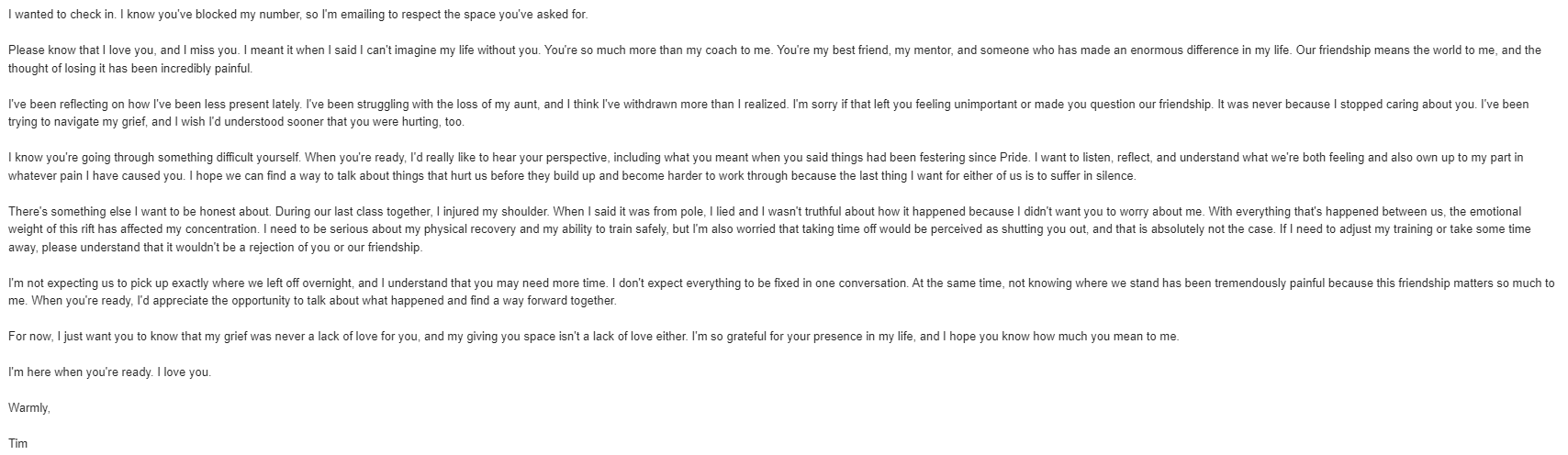
Much to my surprise, he replied that same day.

Shorter in comparison, but concise and to the point. I wanted to jump for joy! Maybe things are coming up for us. This is it.
I’m getting my best friend back!
An attempt at repair
There’s this gay bar in the village called Garage that’s really quiet and peaceful while the sun is up. Nightfall is reserved for loud drag shows and bad karaoke. Two things not conducive to a resolution conversation. We agreed to meet at 5 pm, so we were on borrowed time before the screeching fags took the stage.
On the way there, I was in my head. How do I conduct myself? Am I going to keep it together? I miss him, and I want to hug him. I want him back. I know he’s hurting, so I want us to heal together. I need to choose the right words to say to keep this from getting worse.
As we walked to Garage, we ran into each other in the street, where he greeted me with open arms. Man, have I missed this hug like a fish misses water. It was a relief to know that he wasn’t angry in that moment.
He starts the conversation.
“Just so you know, this wasn’t about you or your dead aunt. It’s just what you said and how cunty I read it made me feel hurt.”
Wow, okay. Coming in hot. Direct. Okay, I guess I’ll follow his lead.
“I hear that. I’m sorry.”
The server interrupts us. “Can I get you guys anything?”
Ray orders two long islands for us, and she gives us our cocktails.
“You sounded like a typical Toronto man. You wanted to hang out on your terms, but what about me? I found out that my grandfather has cancer. And you didn’t even check on me! Like at Pride, you just treated my place like somewhere you drop your bags off and leave. That’s Toronto man behaviour!”
“I’m realising that now. I’m sorry.”
“Oh, are you? Are you sorry?”
Okay, now I’m really confused. Is he actually still angry with me? I thought his email said he wasn’t.
“I don’t know what to say. I’m just sorry. I guess I wasn’t thinking straight.”
“Yeah. You weren’t thinking.”
We sat in silence for a few minutes, trying to figure out what to say. I felt that he wasn’t finished with his thought, so I stayed quiet to give him room, and also because I didn’t really know how to engage with that anger and frustration.
“Could I have chosen another way to voice my anger? Yes. But I come from a dysfunctional family, and yeah I’m working through that. I chose those words because you told me your insecurities and your vulnerabilities, so I weaponised that against you. You had no right to treat me that way.”
“I’m sorry.”
“You know, I can own my part in how I reacted. Yeah, I’ll own it. But you have some fucking nerve. You’re crying and bitching about me at the gym? Tim, you’re an EM-PLOY-EE there. Act like it.”
Yeah, now I really don’t know where his head is at. I’m just as confused, if not more confused, about where his head is at.
“Yeah. I’m sorry.”
“Like fuck me for going through something too. I need to be shown some kindness too rather than be chastised.”
Chastised? Who’s chastising you? Where is any of this coming from?
“I hear you. I’m not here to fight. I care about you a lot, and I want us to be able to work through this hurt without hurting each other or threatening to abandon the friendship.”
“Oh, cut the therapy speak.”
“Sorry. I’m just trying to navigate this in my head. I’m scared of saying the wrong thing, but I know that I shouldn’t hold back on my emotions because while I care about your feelings, your emotions are your responsibility.”
“You don’t have to care for my emotions. I can handle it.”
I sit in silence again. Seriously, what do I even say at this point? He’s so fired up that I’m not sure how to approach him. I thought that a therapist-in-training would respond well to therapeutic jargon.
He breaks the silence.
“You’re in your head too much. You’ll be fine. We’re going to be fine.”
“Are you sure? I just really care about us a lot.”
“Listen, I promise to be better at vocalising my hurt next time.”
Tears are running down my face as the server asks us if we want another round. I barely took two sips from my cocktail. I politely declined as Ray ordered another.
“We’re gonna be okay?”
“Yes, I promise.”
Any rational person who hears this would think that it’s reasonable enough to bring up a concern. He said we’re going to be fine; he said he’ll promise to be better at voicing his hurt. Could I bring up the nickname now?
He huffs. “You’re still in your head.”
“Yeah, I know. I’m just trying to figure out what to say next.”
He gives me the silence I need to process my thoughts, and we sit across from each other, drink in hand, listening to the light bar background chatter for what felt like the longest five minutes of my life. Finally, I get some words out.
“Okay. So, you said that we’re going to be fine, and that we promise to each other that we’ll be better at communicating. In light of that, I want to bring up a concern so it doesn’t, as you put it, fester.”
“Yeah, shoot.”
I let out one long exhale through pursed lips, trying desperately to keep my guts in my body. This is it, Tim. Just say it. You want to heal together? You have to do this.
“What do you know about Rice Tim?”
“What? What is that?”
“A student told me that you were referring to me as Rice Tim?”
“What the fuck are you talking about? Who told you that? Was it Ellie?”
“I mean, yeah…”
“That fucking bitch.”
“Ray, I’m not accusing you. I’m just asking a question.”
“And you didn’t even defend me?!”
“I told her that doesn’t sound like him.”
“ThAt DoEsN’T SoUnD LiKe HiM,” he says in a mocking, juvenile tone.
“Ray, again, this isn’t an accusation. I’m looking for clarification. You promised we would be okay and work through things together.”
He calls up the server and asks for the bill.
“You know, Tim? You’re really fucking something.”
He DARVO’d me. I don’t know what to do at this point. I thought he said we’d be okay. I thought it would be safe enough to bring up my concern. He promised me that he would work on communicating better.
“…” as I sit in silence again.
He looks past me, brow furrowed, lips clenched inwards, skin turning red from anger and alcohol.
The server brings us the machine, and he taps his card to pay for our drinks. She hands him the bill and goes back to her station.
I’m sitting at the table, Long Island still untouched. The sweat from the ice has completely soaked through my paper coaster. My eyes stare into the cloudy, watered-down, overpriced drink with my hands clenched together, desperately trying to keep any more tears I had left from falling.
He looks at me one last time and raises his middle finger.
“Fuck off.”
And he storms out.
The server noticed and asked me if everything was okay. I didn’t know how to answer her.
What now?
I waited for Ray to leave Garage to give him space, so I stayed behind for another ten minutes before forcing my drink down my throat and leaving. I found some peace and quiet on a nearby park bench, where I called some friends, begging to hear some comforting words as I was hurting all over again. I won’t recount every conversation I had, but it boiled down to praising me for keeping it together and vilifying him for the way he reacted. That’s not what I need to hear right now. I don’t want people to think of him as the villain. Even as I type this, I don’t have any negative feelings towards him for how he abandoned me on his terms. I don’t want him painted in a negative light because of how he left my story. What I do want and need is a way forward.
I imagined him as a very important part of my life’s milestones. I made the decision to go back to school because of him. I imagined we would be there for each other’s convocation ceremonies. We spoke about starting a business together where I can teach sex education while he offers therapy. How can someone who’s training to be a therapist, an occupation that requires a tremendous amount of compassion and understanding, treat me so callously, devoid of any compassion or understanding?
So how do I move forward with this? How do I even begin to make sense of grieving a person who is alive and, at the same time, grieving a person who’s no longer alive? It’s a lot to unpack, and I feel almost helpless. I don’t want to be called resilient anymore. I don’t want people calling Ray a horrible person. What I need is to be okay. I need to be okay with letting go of how people react because that isn’t in my control. I need to be okay with myself in knowing that I did my best with what I could control. I controlled my emotions; I wanted to engage with Ray the person, not Ray the victim. He couldn’t control his emotions, and it seemed like he wanted to engage with Tim the Toronto Man, not with me as I was in that moment.
Sometimes, when we're struggling, we withdraw without fully realising how that withdrawal might look to someone else. We assume the people who love us understand that we're having a difficult time. Sometimes they do. Sometimes they interpret our absence as rejection. I can acknowledge that my withdrawal may have hurt Ray. I can understand that he might have felt neglected or wondered whether our friendship still mattered to me. But there's an important distinction between understanding why someone feels hurt and accepting responsibility for everything they do with that hurt. I can apologise for being less present. I can explain what I was going through. I can acknowledge that I might have communicated better. What I cannot do is make myself responsible for managing another person's emotional response to my grief.
That's a difficult lesson for anyone who tends to overthink relationships, especially when you're the kind of person who wants to understand everyone else's perspective before allowing yourself to have your own. You start asking what you could have done differently. You replay conversations. You examine your tone, your timing, your words. You wonder whether you missed a signal or failed to meet an expectation you didn't even know existed.
Reflection can be healthy, but there comes a point when reflection turns into an attempt to find the perfect explanation that will make someone else's hurtful behaviour make sense. And sometimes, even when you understand why someone acted the way they did, the behaviour still isn't okay. It's difficult to describe what happens when someone breaks a promise like that. The hurt isn't limited to the immediate disagreement. It also reaches backwards, making you question the reassurance you received before. You begin to wonder whether the promise reflected a genuine commitment to change or simply what the person wanted to believe about themselves in that moment.
Trying to tie a neat bow
I don't think one bad interaction necessarily defines an entire friendship. People lose their tempers. People make mistakes. People sometimes behave in ways that contradict their values, especially when they're overwhelmed. But a promise to change only becomes meaningful when it's reflected in behaviour. An apology matters. An explanation matters. Understanding what contributed to a conflict matters.
And then there's the question of what happens the next time someone is hurt. Do they pause? Do they communicate? Do they take responsibility for their words? Can they acknowledge the impact of their behaviour without immediately making the conversation about how hurt they feel? Or does the same pattern repeat? That's the part I keep coming back to. Not whether Ray is a good person or a bad person, but whether the friendship can become a place where both of us are allowed to be hurt without either person becoming the other's emotional punching bag. I cannot claim to know everything that happened outside my own experience, and I don't need to pretend that I do. I know what was reported to me, what I raised, how he responded, and how the encounter affected me.
What I know is that I tried to raise something that had hurt me, and the conversation ended in a way that left me feeling even more emotionally depleted. It is possible for two people to remember a situation differently. It is possible for someone to feel falsely accused or become defensive when confronted with something upsetting. Those possibilities don't make it impossible to have a respectful conversation, but a friendship cannot be repaired if every difficult conversation becomes another injury.
I don't want a friendship in which I have to calculate whether bringing up something painful will result in being attacked, dismissed, or abandoned. I don't want to have to make my concerns smaller to keep the peace, and I don't want to become so focused on understanding another person's emotional experience that I lose track of my own. There is a difference between being compassionate and being endlessly available for mistreatment.
One of the traps of caring deeply about someone is that understanding their behaviour can start to feel like an obligation. You learn about their history. You know what they're struggling with. You understand the circumstances that might make certain situations particularly difficult for them. You can see the frightened person beneath the anger, the grief beneath the defensiveness, or the insecurity beneath the need to protect themselves. Because you can see those things, you start making room for behaviour that hurts you.
You tell yourself they didn't mean it. They were having a bad day. They're going through something. They didn't know how to express what they were feeling. Maybe all of those things are true, but understanding why someone hurts you doesn't mean you have to keep putting yourself in a position to be hurt.
This is particularly difficult when the person is someone you admire. Ray is training to become a therapist, and I have struggled with the apparent contradiction between the emotional safety we associate with therapeutic work and the way our own conflict has unfolded. But I don't think it's helpful to turn that contradiction into a verdict on his entire character. People can understand healthy communication intellectually and still struggle to practise it in their personal lives.
The more important question is whether someone is willing to recognise that gap and work on it. I can have compassion for what Ray might be experiencing without becoming responsible for resolving it. I can acknowledge that he may have his own account of our conflict without abandoning mine. And I can love him without accepting every version of our friendship that he might be willing to offer.
Love does not require self-abandonment. I still want reconciliation. I want us to reach a place where we can talk honestly, understand each other's experiences, and rebuild the trust that has been damaged. I don't want to pretend three years of friendship meant nothing because our most recent interactions have been painful. But wanting reconciliation and pursuing someone indefinitely are two very different things.
For a long time, the uncertainty has left me wondering what I should do next. Should I reach out again? Should I give him more time? Should I explain myself differently? Is there something else I could say that would make him understand? Those questions make sense when a relationship matters to you, but they can also keep you trapped in a cycle where you're doing all the work to preserve a connection that requires two people to sustain.
I have already made an effort to communicate. I have expressed that I care. I have made room for a conversation. At some point, the next step has to come from him. That isn't punishment. It isn't a test designed to see whether he loves me enough to chase me. It's a recognition that I cannot repair a friendship on behalf of both people. If Ray wants to work through what happened, I want that possibility to remain open. But I need him to participate in that process. I need accountability, mutual respect, and a willingness to have difficult conversations without turning them into personal attacks, and I need to see those things in practice, not simply hear that they matter.
I'm beginning to understand that I can leave the door open without standing in the doorway waiting for him to walk through it. I can miss him without contacting him. I can hope that he eventually wants to repair our friendship without putting my life on hold until he decides. I can grieve what we've lost without deciding that everything we shared was meaningless. And I can accept that I don't control whether he comes back, what he understands, or whether he's willing to do the work. That's not giving up on someone. It's recognising the limits of what love can accomplish when it isn't being met with reciprocal effort.
There's no clean ending to this kind of loss.
The person is still out there. You remember their voice, their mannerisms, the jokes that only the two of you understand. You might still visit the places where you spent time together. You might still encounter them in a community that matters to you. In my case, the friendship is also connected to the gym, a space where I have invested time, energy, and a sense of belonging. Losing emotional security in that relationship doesn't simply affect my private life. It affects how comfortable I feel participating in something I care about. That makes the grief complicated. You cannot always create distance from a person without also navigating the parts of your life that overlap with theirs.
And because there hasn't been a definitive ending, there's room for hope to keep reopening the wound.
Maybe he'll reach out tomorrow. Maybe he'll understand next week. Maybe enough time will pass that we'll both be ready to have a different conversation. Those possibilities exist. But they cannot become the conditions under which I'm allowed to move forward. I don't have to decide today that our friendship is over forever. I also don't have to behave as though the friendship is intact when it currently doesn't feel safe or reciprocal. I can take the relationship as it exists right now, rather than as I desperately wish it would be.
And right now, I'm exhausted.
I'm exhausted by the uncertainty, by replaying the conversations, by trying to make sense of how someone I love can respond to my hurt in ways that create more hurt. I'm exhausted by the tension between wanting to protect the friendship and needing to protect myself. That exhaustion deserves attention, too. Sometimes we become so preoccupied with whether a relationship can be saved that we forget to ask what the attempt to save it is costing us. You don't have to stop loving someone to choose yourself.
I wish there were a neat lesson here. A sentence that would make the situation click into place and allow me to stop missing someone who has hurt me.
There isn't.
I'm still grieving. I'm still trying to understand what happened. I still love Ray, and I still wish things could be different. I'm learning that love is not the same thing as access. Caring about someone doesn't mean they are entitled to unlimited opportunities to hurt you. And having compassion for another person's struggles doesn't mean you have to sacrifice your own emotional well-being to prove that compassion is genuine.
A friendship can be meaningful and still become unhealthy. Someone can matter enormously to you and still be unable, at least right now, to participate in the kind of relationship you need. Those truths can coexist. I don't need to hate Ray to acknowledge that what happened hurt me. I don't need to diagnose him, discredit him, or convince other people that I'm right in order to take my own experience seriously.
I don't need to close the door forever. But I also don't need to keep knocking.
If we find our way back to each other, I hope it will be through mutual effort, honest conversations, accountability, and a genuine commitment to treating each other differently. I hope we can build a friendship in which neither of us has to be afraid of expressing hurt. I would welcome that. But until then, I have a life to keep living. I have grief to process, relationships to nurture, and a responsibility to myself to stop treating uncertainty as a problem I can solve through enough effort.
Perhaps that's the hardest part of loving someone through a rupture: accepting that you can do everything within your control and still not get the outcome you want. You can offer understanding. You can apologise for your part. You can communicate honestly. You can make space for repair. Then you have to let the other person decide what they're willing to do with that invitation.
I'm not giving up on the possibility of reconciliation. I'm giving up on the idea that I have to carry the entire possibility of it by myself.
And if there's one thing I want to remember as I navigate this, it's this: I can love someone, wish them well, and hope they find their way back to me without abandoning myself in the process.
Sometimes choosing yourself doesn't mean you stop loving the other person.
Sometimes it means you finally make room for your own pain, too.
